Engine Installation
Installing the engine and hooking it up turns out to be a major undertaking. After all, there are no plans, everything has to be invented, plus the engine is changed from inverted to upright, presenting another set of challenges. Progress is tedious and slow, but progress never the less.
First, the engine gets moved forward about 4" and lowered by about 3" to allow more visibility:

see new motor mounts, allowing drop
Next, fuel system
.jpg)
carburetor ready

gascolator

fuel shutoff

dual fuel pumps
Then comes the throttle control,
.JPG)
Throttle in cockpit
.jpg)
carburetor end
Then comes air intake and vapor separator

custom air intake

vapor separator
Next Big job: Oil tank

fitting

fitting

fitting

more fitting

trying again and again

ready for welding

welded

welded

pressure testing
Another biggie: enclosure

belly shield

belly shield

3 stiffeners

attachments

left front shield

ready for riveting
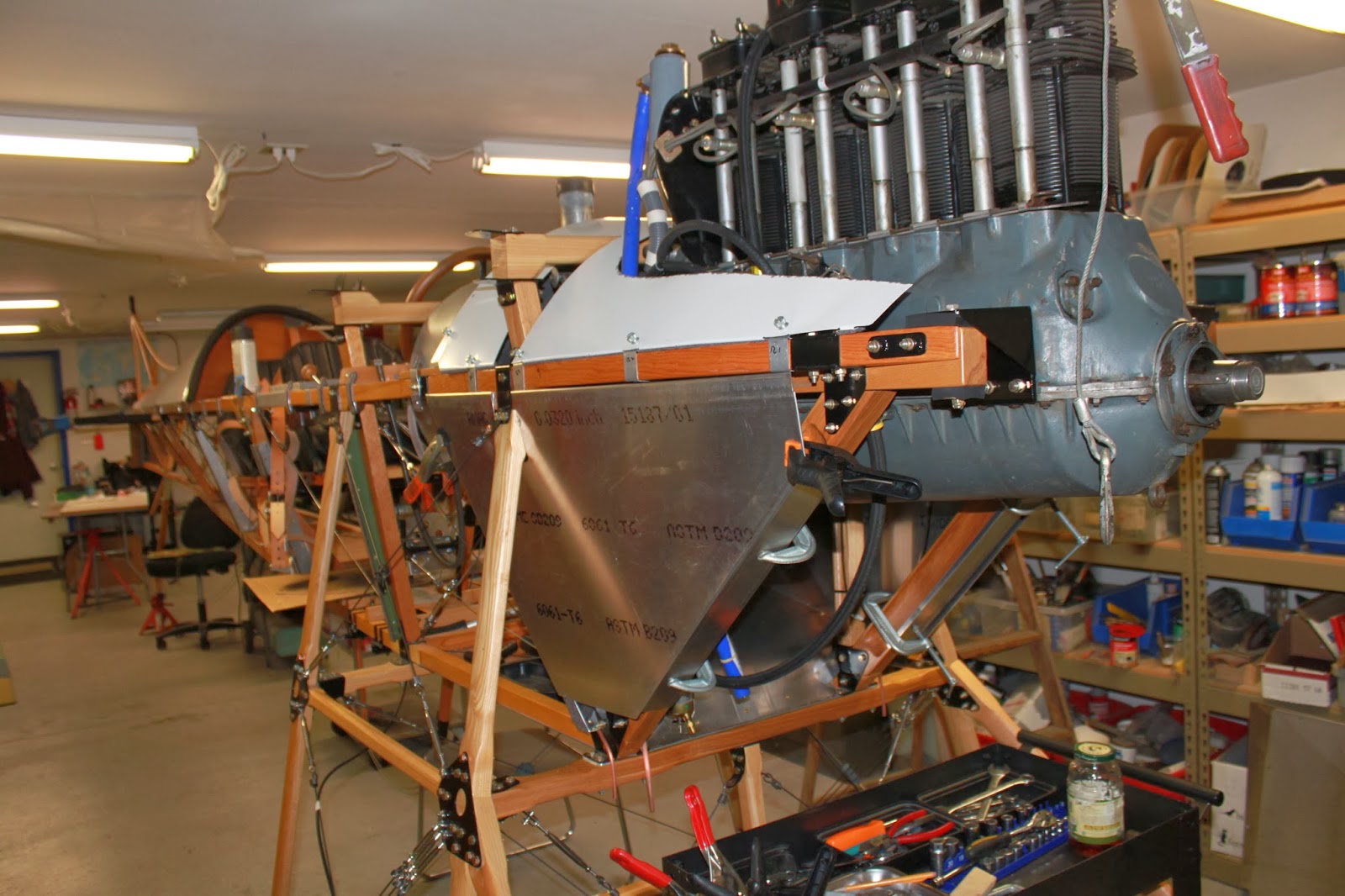
right front shield

right front shield
At this point I should really mention as to what inspired this project. Well, I guess it's in the genes. My grandfather Robert Eyb was one of the first pilots back in Austria, when the Austro-Hungarian Empire wanted to get into aviation, as all great powers did at that time. Military of course. The aircraft they ordered was the model F Taube, designed by Igo Etrich and built by Lohner Werke AG in Vienna, Austria. They ordered 14 of them and specified that it had to be able to carry a pilot and observer, be able to land and take off again from a freshly plowed field, welding to be kept a minimum. The result was the F series, featuring a four-wheel castering landing gear, a 90 HP Daimler water cooled engine and a unique seating arrangement with the pilot in front and the observe directly behind him. No serial numbers, the airplanes had names, staring with the letter "A", for Austria, of course. His was the ASRA. That was 1912. These airplanes were all built in an amazingly short time, ordered in June and delivered in September. October 2 2012 was an important day, the military put on a demonstration flight for the public. The placards announced that it would take place " in any weather". Winds were high, but they flew anyway, because at that time the airfields were simply large fields and you always took off and landed into the wind. Always. No cross wind techniques needed. In my grandfather's personal memoirs he later mentions that day the commanding officer was highly annoyed that the flight officer took liberty of making that weather decision on his own. He also mentions how he took off with the ground, black with people below, along with the flight leader and at some altitude they both changed course and on the ground it appeared they were crossing paths and would collide imminently. He then had to fly to Sopron, about 35 miles away accompanied by another officer in his airplane. They encountered a cloud layer and my grandfather continued on top, the other below and later lost visibility and crashed into a vineyard. My grandfather's compass failed above the clouds, however he was able to use a stopwatch, a tiny pocket compass and at the right time cut the engine, put the airplane into a shallow spiral and came out of the clouds exactly above the airfield with a cheering crowd. Here is the one and only photo of him and the ASRA:

Grandfather Robert Eyb at the Offiziersfligen October 2 1912, Wiener Neustatt, Austria
He also published a book in 1914 on the status of aviation at that moment in time, which is extremely helpful in my research and decision making as I am building this full scale replica. I was able to get partial plans from Heinz Linner in Austria, who also built an F version about 40 years ago, ( albeit not as authentic as mine will be ), here is his version, currently in Peter Jackson's museum in Australia:

Heinz Linner's F Taube ca. 1960
Seating arrangement and engine setup not authentic. 
Heinz Linner's F Taube in Vienna's Technische Museum
Here's a photo of the D version, just to show the beauty of this bird

D-version ( Later German version by Rumpler), to show the beauty.

A shot of the F plans, note wingspan 47 feet. !

Typical framework of the D version. F is similar, different seating and landing gear.
So, having been born in Vienna in 1941 and grown up in Europe, mostly in Austria, it's comes natural for me to build this full scale replica. People ask me " why " I say " because I want to - and I can" . How long will it take? how much will it cost? You never count time or money when it comes to women or airplanes. Period.


